
Custom Bag Printing Methods: How to Choose the Right Process
Quick answer: The best printing method for a custom bag depends on its fabric, artwork, order quantity and intended feel. Screen printing works well for repeat orders with simpler graphics; reactive printing can give suitable cotton and other compatible fabrics a softer hand; dye sublimation is suited to polyester and detailed all-over designs; and digital direct printing helps with complex artwork and smaller runs. Special effects can add texture or shine, but each should be sampled on the actual bag material before bulk production.
At Senrong Bags, we develop OEM/ODM bags with custom graphics and finishes for brands, retailers and promotional buyers. A print that looks good on a flat swatch must also work after the material is cut, sewn and used. That is why we review the design, substrate and construction together rather than choosing a print technique from the artwork alone. Explore our OEM/ODM service or browse canvas bag styles for project ideas.
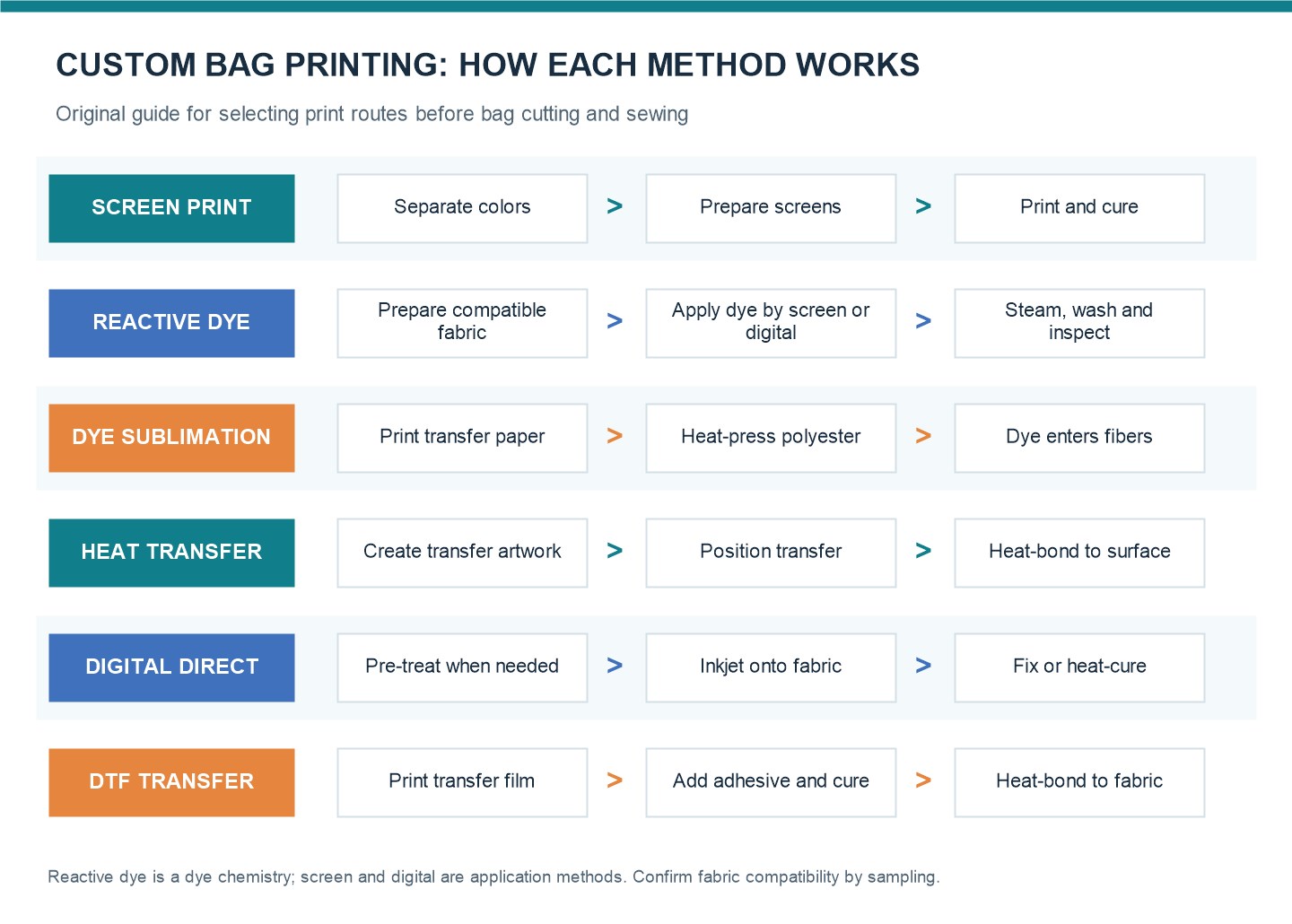
Four common printing routes for custom bags
1. Screen printing
Screen printing transfers ink or print paste through a screen onto the fabric. It is a practical choice for logos and graphics with a limited number of solid colors, especially when the same design will be repeated in volume. Different ink systems can produce different opacity and hand feel. Dark fabric, for example, may require an opaque underbase or a suitable paste. Each additional color generally requires its own screen and registration, so complex gradients and photographic images can become less economical. Screen printing is possible on many bag fabrics, but adhesion and wash performance must be checked for the specific material, coating and ink combination.
2. Reactive printing for compatible fabrics
Reactive printing uses dyes that bond with suitable fibers rather than simply forming a raised layer on top. For an appropriate cotton or other compatible fabric, the result can feel soft and breathable. The process usually involves fabric preparation, printing, steaming to fix the dye, washing to remove unfixed color, drying and inspection. Those extra steps affect cost and lead time. Reactive printing is not a universal choice for polyester, and its suitability for dark bases or blended fabrics should be confirmed during sampling.
3. Dye-sublimation printing
Dye sublimation uses heat to transfer color into polyester fibers. It can reproduce detailed, multicolor or photographic artwork without a thick surface feel. It is especially useful for light-colored polyester panels that will later be sewn into a bag. It is not the right process for an ordinary 100% cotton tote. Artwork placement, seam allowances and fabric color need to be considered before printing large panels or all-over patterns.
4. Digital direct printing
Digital textile printing sends artwork directly from a digital file to a prepared fabric, avoiding a separate screen for every color. It is useful for sampling, smaller runs, gradients and detailed illustrations. Ink chemistry and pre-treatment depend on whether the fabric is cotton, polyester or a blend. A dark base may also need a white underbase. Digital printing can be more flexible than screen printing at low quantities, while unit cost for larger repeat runs should be compared case by case.
Heat transfer and direct-to-film (DTF) are additional routes for selected logos and graphics. They use a transfer layer bonded to a compatible fabric with heat. Depending on the construction, this can be useful for full-color artwork or dark fabrics, but the surface feel is different from a dye that enters the fiber. Flexibility, adhesion and wash performance must be checked on the actual bag material.
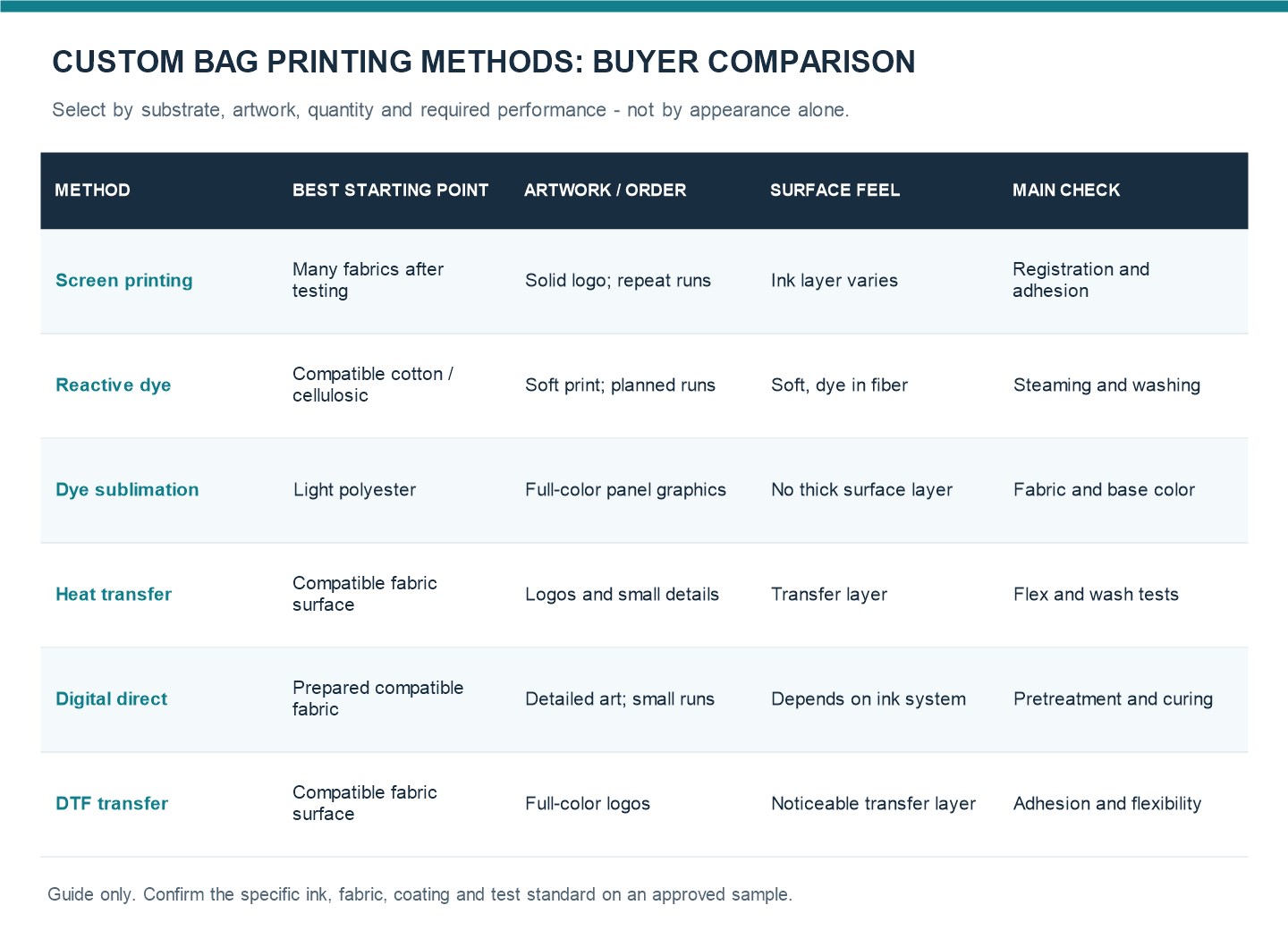
| Method | Typical starting point | Key check |
|---|---|---|
| Screen printing | Solid logos and repeat runs on tested fabric | Color registration and ink adhesion |
| Reactive dye | Compatible cotton or cellulosic fabric when a soft hand matters | Steaming, washing and shade consistency |
| Dye sublimation | Detailed artwork on light polyester | Base fabric and color response |
| Heat transfer | Selected logos on compatible fabric | Bond strength and flex performance |
| Digital direct | Detailed artwork and smaller runs | Pretreatment and curing |
| DTF transfer | Full-color graphics on compatible fabric | Adhesion and flexibility |
Special print effects: texture, shine and visibility
The reference video also illustrates effect finishes such as puff printing, flocking, metallic foil, heat-transfer graphics, reflective printing, high-density raised prints, silicone printing and crackle effects. These are design options, not substitutes for checking the base fabric and its coating. For example, a raised print can make a logo more tactile, while a reflective detail may help a design stand out under light. Flexing, abrasion, cleaning and colorfastness should be evaluated on a sewn sample where relevant. We do not assume that every special effect works on every material.
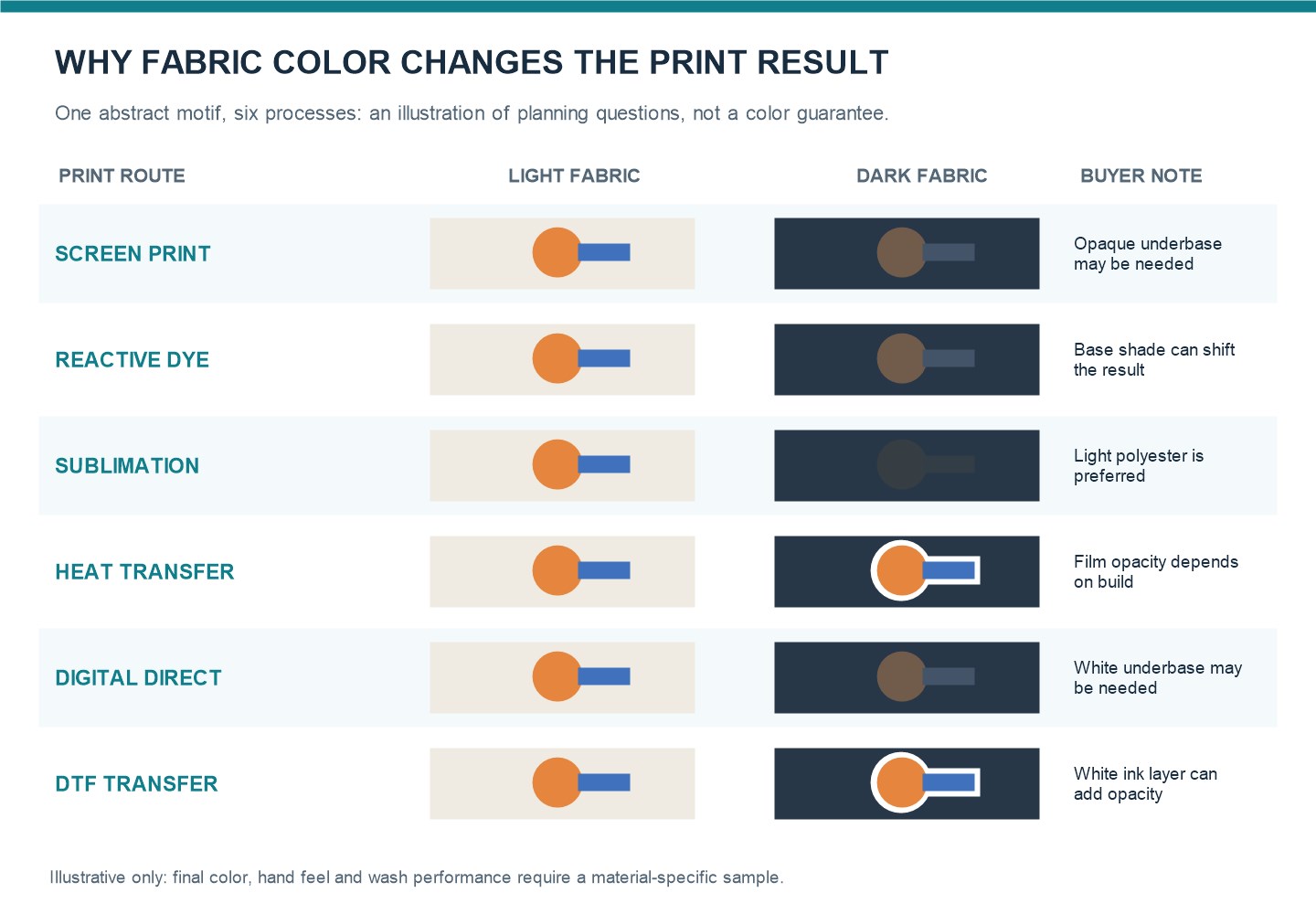
How Senrong selects a print method
For a simple logo on a larger batch of custom canvas bags, screen printing may be the first option to compare. For a soft printed cotton surface, a reactive route may be worth testing. For a full-color polyester backpack panel, sublimation may fit the artwork better. For a small run of detailed cosmetic bags, digital printing may reduce setup work. Final feasibility and pricing depend on the exact material, design size, number of colors, order volume and performance requirements.
Senrong supports customization of these printing routes and selected special effects as part of bag development. We use seven quality inspection checkpoints in the production workflow and work to keep defects low. Print approval considers the approved artwork and color target; subsequent checks may include registration, appearance, adhesion or colorfastness as applicable, as well as the finished bag. The test plan is agreed according to the chosen material, method and buyer specification. We do not quote a universal defect-rate percentage because it varies by project.
What to send when requesting a printed bag quote
To receive a useful recommendation, share the bag style, fabric composition and any coating, logo artwork in a vector or high-resolution file, print size and placement, target colors, expected order quantity, destination market and any testing standard you require. If you have a reference sample, photographs of its front, back and close-up print texture are helpful. Senrong can then compare suitable methods, develop a sample and confirm the production specification before bulk manufacturing.
Frequently asked questions
Which method is best for a cotton tote bag?
For a simple logo and larger quantity, screen printing is often a sensible starting point. If a soft, dyed-in feel is important, ask whether reactive printing is appropriate for the selected cotton fabric. Confirm both options on samples.
Can a photo be printed on a custom bag?
Yes, but the material matters. Sublimation is a strong option for suitable polyester; compatible digital textile printing may be used for other fabrics. A photo is generally less suited to conventional multi-screen printing.
Can every print effect be used on every bag?
No. Fiber type, fabric color, surface coating, stretch, seam location and cleaning requirements can all change the result. We recommend a material-specific sample and agreed test criteria before confirming a special effect for production.
Planning a custom printed bag collection? Contact Senrong Bags with your artwork and bag requirements to discuss materials, print samples and OEM/ODM production.