
Cloud Cosmetic Bag Manufacturing & Cost Guide Suggested Slug: cloud-cosmetic-bag-manufacturing-process-cost
The cloud cosmetic bag analyzed in this guide is a soft zippered makeup pouch with a three-dimensional quilted body. It is made by quilting a face fabric, soft batting, and a stretch backing together. The quilting contracts the three layers and creates raised, cloud-like cells. This gives the cosmetic bag its soft, puffy appearance, but it also reduces usable material area and makes cutting and sewing more complex than for a conventional flat-fabric makeup pouch.
According to the original production analysis, the four main cost drivers are quilting shrinkage, laser cutting, quilt-grid alignment, and an additional stabilizing-stitch operation. Understanding these points before sampling helps a buyer set realistic appearance tolerances, compare quotations accurately, and avoid unexpected material or labor charges.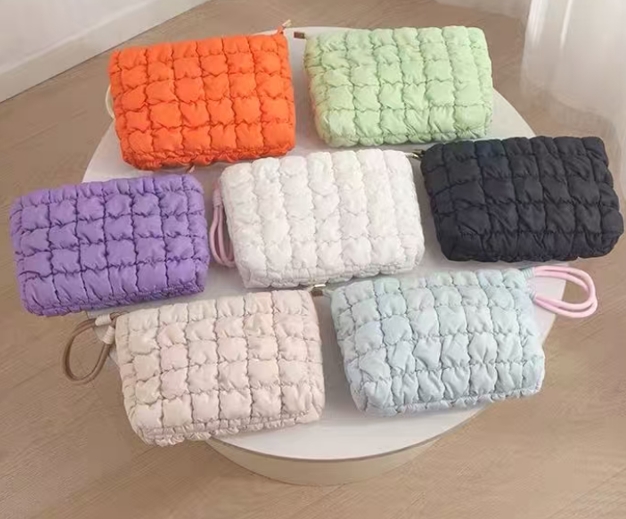
What Is a Cloud Cosmetic Bag?
A cloud cosmetic bag is a makeup pouch with a soft, three-dimensional quilted surface. Its raised cells are not printed or embossed onto the material. They are formed when the layered material is stitched and allowed to contract. The product in the original production presentation has a rounded rectangular pouch shape, a zipper closure, a raised square-grid texture, and a soft, full hand feel.
A typical material structure includes:
- Face fabric: usually nylon, polyester, or another lightweight woven fabric selected for the required color, hand feel, and performance.
- Batting: a soft polyester batting or wadding layer that provides volume.
- Stretch backing: an elastic fabric that helps the stitched cells contract and rise.
The original analysis identifies the quilt-grid size as a customizable specification. Buyers looking for other makeup pouch constructions can browse Senrong’s custom cosmetic bag collection.
Cloud Cosmetic Bag Manufacturing Process
1. Prepare and Inspect the Materials
The face fabric, batting, and stretch backing are checked for color, width, thickness, stretch, and visible defects. Stretch performance is especially important because different material batches can contract at different rates after quilting.
Before bulk production, the factory should quilt a test section and record both its original dimensions and its relaxed dimensions. This test provides a more reliable basis for material consumption and finished-cell tolerances.
2. Combine the Three Layers and Quilt the Pattern
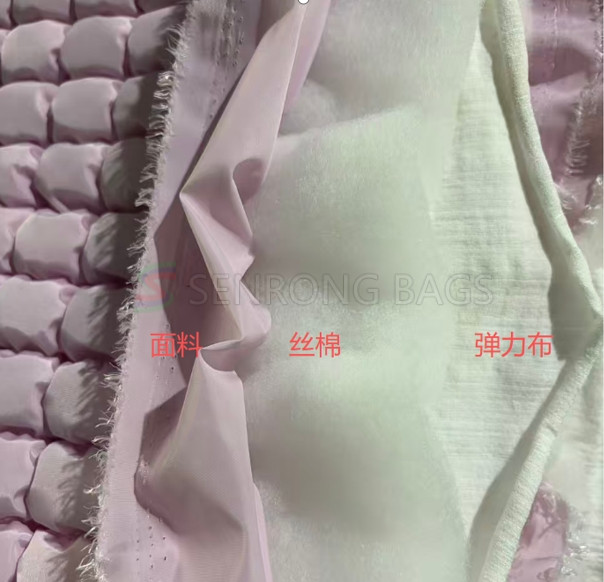
The face fabric, batting, and stretch backing are placed together and quilted with the selected grid. As the stitch pattern is completed, the stretch backing contracts and the batting pushes the face fabric upward. This creates the rounded, three-dimensional cloud effect.
The finished grid should be evaluated after the quilted material has relaxed, not immediately after it leaves the machine. In the production example used for this analysis, the requested finished cell size was approximately 3–3.5 cm.
3. Let the Quilted Material Relax
Quilted material may continue to recover and contract after stitching. For the sample order analyzed here, the material was left flat for approximately 24 hours before final measurement and cutting.
This relaxation step helps the factory:
- measure the actual shrinkage rate;
- identify batch-to-batch variation;
- reduce dimensional errors during cutting; and
- calculate a more realistic usable yield.
4. Laser-Cut the Three-Dimensional Material
After shrink quilting, the material is no longer a stable, flat sheet. Raised cells and elastic recovery can cause a traditional steel-rule die to shift or compress the material, which may distort the cut panel.
Laser cutting is therefore used for the cloud cosmetic bag in this production analysis. It offers accurate positioning and better control over irregular, three-dimensional quilted panels. It is slower and more expensive than high-speed die cutting, but it reduces the risk of misaligned or deformed parts.
5. Add Stabilizing Stitches
The cut panel may have an uneven surface and can continue to recover around its edges. A stabilizing-stitch operation is added to hold the panel shape before final assembly.
This step is not usually required for a standard flat bag panel. It adds handling time, slows sewing output, and must be included in the labor calculation.
6. Assemble, Inspect, and Pack the Bag
The stabilized quilted panels are combined with the lining, zipper or other closure, handles or straps, labels, hardware, and internal components. The finished bag is then checked for dimensions, cell consistency, panel alignment, sewing quality, appearance, function, and packaging.
Senrong’s quality-control checkpoints and customization capabilities are described on the company’s advantage page.
Why Does a Custom Cloud Cosmetic Bag Cost More?
Quilting Shrinkage Reduces Material Yield
Shrinkage is the largest cost factor. In the sample order used for this production analysis, one yard of layered material contracted to about 0.7 yard in length after quilting. A starting width of 1.47 m contracted to approximately 1.0 m.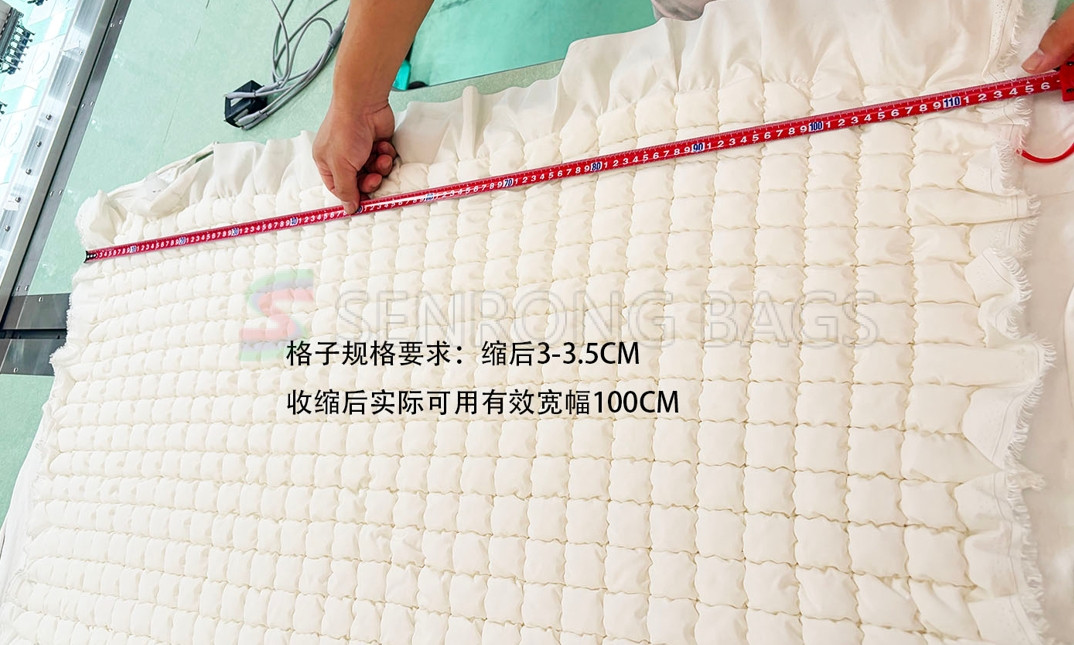
After shrinkage and production allowances were considered, the effective material utilization in that example was approximately 44%. This is a case-specific manufacturing result, not a fixed ratio for every cloud cosmetic bag. Actual yield depends on:
- face-fabric construction;
- backing elasticity;
- batting thickness;
- stitch density;
- finished cell size;
- panel dimensions;
- grid-position requirements; and
- nesting efficiency.
Because shrinkage can vary by material batch, a reliable bulk quotation should be based on a tested quilted sample rather than on raw fabric width alone.
Laser Cutting Adds a Separate Processing Cost
Conventional die cutting is fast and economical for flat, stable materials. A cloud-quilted surface is raised, soft, and elastic, so precision laser cutting is often a better choice.
In the analyzed order, laser cutting added approximately RMB 0.5–0.8 per panel, depending on panel size. This figure is a production example only. The actual cost will vary with dimensions, cutting time, local processing rates, order quantity, and the number of panels.
Grid Alignment Increases Waste
Some designs require the quilted cells to appear in the same position on every finished bag. To achieve this, each pattern piece must be cut from a fixed position in the quilted grid.
That restriction limits how tightly pattern pieces can be nested. In the sample analysis, the alignment requirement added approximately 5–10 percentage points of material waste and brought total waste close to 50%.
If exact grid alignment is not essential to the design, allowing controlled variation can improve material yield and reduce cost.
Stabilizing Stitches Increase Labor
The non-flat material needs more handling than an ordinary flat panel. The additional stabilizing-stitch operation reduces sewing efficiency and adds labor. In the sample cost model, this operation increased the estimated labor component by approximately 5%.
The effect on a final quotation depends on bag construction, panel count, size, seam type, lining, hardware, and the degree of alignment required.
Production Example at a Glance
| Item | Example | Why It Matters |
|---|---|---|
| Finished quilt cell | Approximately 3–3.5 cm | Cell size affects loft, shrinkage, appearance, and yield |
| Material length after quilting | 1 yard reduced to about 0.7 yard | Less usable material remains after contraction |
| Material width after quilting | 1.47 m reduced to about 1.0 m | Fewer panels fit across the usable width |
| Effective material utilization | Approximately 44% | Material consumption must be based on finished yield |
| Additional alignment waste | Approximately 5–10 percentage points | Fixed grid positioning limits nesting |
| Laser-cutting reference | Approximately RMB 0.5–0.8 per panel | Three-dimensional material requires slower precision cutting |
All figures above come from one production analysis and should be used as sourcing references, not universal price rules.
How Buyers Can Control Cloud Cosmetic Bag Cost
1. Define the Finished Cell Size, Not Only the Stitch Pattern
State the required cell size after quilting and relaxation. Also define an acceptable tolerance range because elastic materials naturally vary.
2. Decide Whether Exact Grid Alignment Is Necessary
Perfect cell positioning on every panel creates additional waste. If the design can accept a controlled, non-positioned layout, ask the factory to compare both options.
3. Approve a Full Quilted-Material Sample
A small fabric swatch may not show the true shrinkage or visual rhythm of a complete bag panel. Approve a sample large enough to verify cell size, loft, color, hand feel, and cutting behavior.
4. Test Every Important Material Batch
Elastic recovery can vary between batches. A pre-production shrinkage test helps confirm consumption, panel dimensions, and appearance before bulk cutting.
5. Quote from Finished Yield
Ask the supplier to calculate consumption after quilting and relaxation. A quotation based only on raw fabric area can underestimate the real material requirement.
6. Confirm the Complete Specification Before Pricing
For an accurate cloud cosmetic bag quotation, provide:
- bag dimensions and intended use;
- reference photos or a technical drawing;
- face fabric, batting, and backing requirements;
- finished cell size and shape;
- grid-position or alignment requirements;
- lining, closure, straps, pockets, and hardware;
- logo method and logo size;
- order quantity and color breakdown;
- packaging requirements; and
- target market or compliance requirements.
Senrong’s OEM and ODM workflow explains the available development services.
Cloud Cosmetic Bag Quality-Control Checklist
During sampling and bulk production, check:
- finished quilt-cell dimensions after relaxation;
- shrinkage in both length and width;
- consistency between material batches;
- even batting distribution and cell loft;
- grid position at visible seams and panel edges;
- left-to-right symmetry when the design requires it;
- cut-panel dimensions before assembly;
- stabilizing-stitch position and tension;
- seam puckering, skipped stitches, and exposed thread ends;
- handle, strap, zipper, and hardware security;
- finished bag dimensions and function; and
- final color, appearance, labeling, and packaging.
Buyers who want to understand the available production environment can review Senrong’s factory photos.
Product Specifications in the Original Analysis
- Product: cloud cosmetic bag with a zippered pouch shape
- Material structure: face fabric, soft batting, and stretch backing
- Forming method: three-layer shrink quilting
- Visual feature: raised cloud-like square cells
- Hand feel: soft and puffy
- Custom option identified in the presentation: quilt-grid size
Explore Senrong’s cosmetic bag styles for other pouch shapes and material options.
Working with an Experienced Custom Bag Manufacturer
A cloud cosmetic bag should not be priced in the same way as a conventional flat-fabric cosmetic pouch. The supplier needs to understand shrink quilting, material relaxation, three-dimensional cutting, controlled grid positioning, and stabilizing stitches.
Senrong has produced custom bags since 2002 and supports OEM and ODM development for international buyers. Learn more about the company.
Frequently Asked Questions
What materials are used to make a cloud cosmetic bag?
The product analyzed in the original presentation uses a face fabric, soft batting, and a stretch backing. These three layers are quilted together to create the raised cloud texture.
Why is a cloud cosmetic bag more expensive than a regular cosmetic pouch?
Shrink quilting reduces usable material area. The raised material may also require laser cutting, controlled grid alignment, extra handling, and stabilizing stitches. These steps increase material consumption, cutting cost, and labor.
Can the quilt-cell size be customized?
Yes. The stitch grid and finished cell size can be customized. Buyers should specify the required size after quilting and relaxation, together with an acceptable tolerance.
Is laser cutting always required?
Not in every design, but it is often the better choice for raised, elastic, or irregular quilted material. The factory should evaluate the material stability, panel shape, tolerance, and order volume before selecting the cutting method.
How can a buyer reduce material waste?
Allow practical cell-size tolerances, avoid exact grid positioning when it is not visually necessary, test shrinkage before bulk production, and optimize the pattern layout using the relaxed quilted material dimensions.
What information is needed for a quotation?
Provide the bag size, material preference, finished quilt-cell size, alignment requirement, construction details, logo method, order quantity, packaging, target market, and reference artwork. A physical sample or technical drawing is especially helpful.
Request a Custom Cloud Cosmetic Bag Quotation
Planning a custom cloud cosmetic bag? Send Senrong your pouch dimensions, reference images, material requirements, finished quilt-cell size, alignment standard, zipper and lining details, logo requirements, quantity, and packaging needs. The team can review the construction and prepare a project-specific sampling and quotation plan.
Contact Senrong to discuss your custom cloud cosmetic bag project.