
Custom Ski Backpack and Wheeled Ski Bag: A Two-Bag Design Guide
Traveling with ski gear creates two different packing problems. A custom ski backpack needs to organize boots, a laptop, clothing and small essentials without becoming uncomfortable to carry. A wheeled ski bag must secure long equipment and protect the interior from sharp edges while remaining manageable through airports and stations. An anonymized design brief explored both products as a coordinated travel system. This article turns its requests into a practical development guide; the dimensions and features are proposals, not verified specifications or evidence that these exact bags have been manufactured by Senrong Bags.
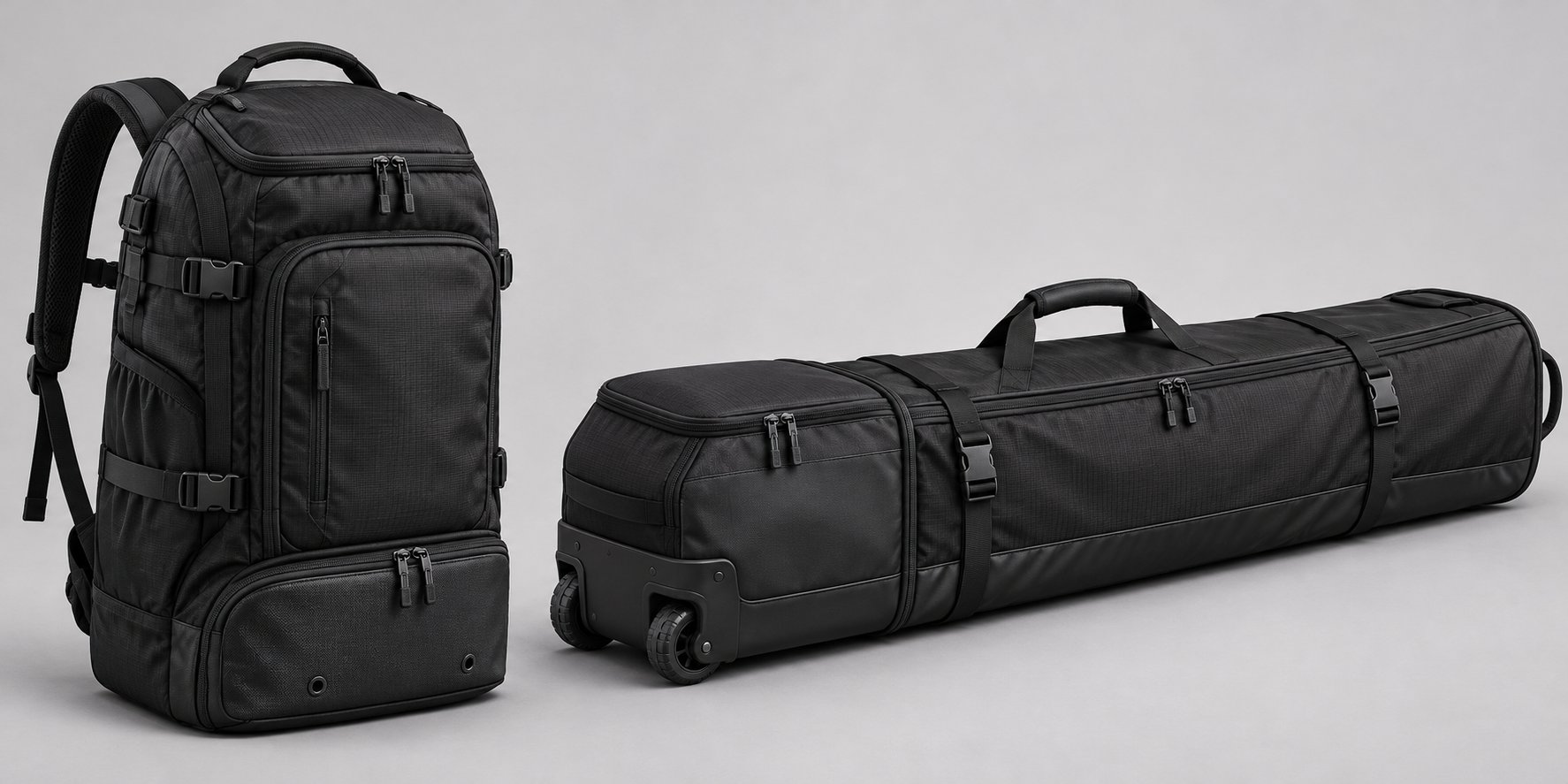
Two bags, two different jobs
The brief begins with a travel backpack concept and then develops a separate, larger rolling ski bag. They should not be combined into one untested product specification: the load, carry method and internal protection are different.
| Design point | Ski boot travel backpack | Wheeled ski equipment bag |
|---|---|---|
| Capacity | About 50 L target | About 100-120 L target |
| Reference size | About 55 × 38.75 × 21.25 cm, subject to a packing test | Long enough for the intended skis or snowboard; exact dimensions still open |
| Weight goal | Preferably no more than 2.5 kg | Preferably below 4 kg |
| Priority | Comfortable carry and organized access | Stable rolling, equipment retention and interior durability |
These capacity, dimension and weight figures are targets rather than final measured results. In particular, the proposed backpack dimensions must be reconciled with the desired 50 L usable capacity after the compartments and padding are developed.
Design the 50L ski backpack around real gear
The proposed backpack needs dedicated places for ski or snowboard boots, gloves, goggles, a toiletry kit, a phone and power bank, a passport, a water bottle and chargers. It also mentions a laptop up to 17 inches and a tablet, alongside books, headphones, a wallet and clothing such as a ski jacket, base layers and socks. That list is ambitious for a carryable bag, so the first prototype should be packed with the actual equipment before the capacity or pocket layout is approved.
The brief asks for separate glove and goggle pockets, rather than leaving these items loose in the main compartment. A side-access opening with an additional zipper is suggested, as is a possible helmet solution. Helmet storage remains an open design question: an exterior holder, a protective hood or an internal restraint would each affect space and carrying comfort. An optional carabiner attachment and an accessible bottle pocket should be placed where they do not interfere with the shoulder straps or rolling luggage.
Phone and power-bank pockets are requested, with USB and USB-C access considered as optional features. If charging access is selected, cable routing, connector specifications and destination-market requirements should be reviewed during development; the bag should not be described as including a power supply unless one is specified.
Separate compression ideas from proven construction
The source considers vacuum-style storage and an expansion zipper to make the backpack more adaptable. Later notes suggest that removable compression bags may be more practical than building a vacuum system into the backpack. One proposed arrangement is two smaller compression bags sized for clothing, but their dimensions and interaction with the boot compartment are not fixed. Sample testing should compare accessibility, sealing, added weight and how much usable space remains after compression.
The backpack is also intended to fold or roll smaller for storage. That goal may conflict with rigid reinforcements, extensive pockets or a large boot compartment. A pattern and material trial should determine whether meaningful compact storage is possible without damaging the bag’s structure.
Plan the wheeled ski bag around equipment retention
The second product is a larger wheeled ski travel bag intended to carry skis or a snowboard, boots and potentially a helmet. Its proposed 100-120 L capacity and sub-4 kg weight are not yet reconciled with the required length, wheels, dividers and padding. A centered carry handle and durable, smooth-running wheels are priorities. Exterior clips are mentioned as a possible option, but the brief also warns that poorly placed clips could hinder rolling or folding.
Inside, the design calls for a secure ski-retention system and possible straps for poles. A separate boot zone is proposed, with a provisional 40 × 40 cm footprint, a water-resistant lining, a stiffer divider between boots and clothing or compression bags, and straps to prevent the boots from shifting. Helmet placement remains undecided; a protective outer hood or an internal mesh restraint are options to prototype, not established features.
Because ski edges can abrade or cut ordinary linings, the interior needs an appropriate protective material and reinforcement where equipment contacts the bag. A material description alone cannot prove cut resistance. The factory and buyer should agree on the expected edge-contact points and test the finished construction with representative equipment.
Compare materials without assuming certifications or performance
The brief lists several candidate materials rather than a final bill of materials: 300D or 600D ripstop polyester, heavier 1680D ballistic-style polyester or nylon, TPU-backed fabric, reinforced technical textiles and PE-based tarpaulin-style lining. It also mentions premium zippers, durable stitching and lightweight construction. The backpack’s outer material is requested to resist water; for the large ski bag, the brief prioritizes toughness over full waterproofing. Neither bag should be called waterproof or cut-proof without product-level testing.
Recycled-fabric and OEKO-TEX or GRS documentation are raised as procurement considerations, not confirmed certifications for a selected material or finished bag. Before making a public claim, verify the supplier, component scope, certificate validity and applicable transaction documentation.
What should the first prototype answer?
Before sampling, the buyer and factory should agree on the actual ski or snowboard length, boot size, helmet dimensions, laptop size and expected total packed weight. The backpack sample should be checked for fit, access, shoulder comfort, zipper operation and realistic packed capacity. The wheeled bag sample should be rolled under load and checked for wheel attachment, balance, handle placement, dividers, boot restraint and abrasion at the ski-edge contact zones.
Send artwork only when its use is authorized, and keep any requested material certification separate from unverified design references. For related OEM development options, browse Senrong Bags’ custom backpack category and sports bag range. To discuss a ski-travel project, contact the team with your equipment dimensions, capacity target, material requirements and destination market.
Frequently asked questions
Is the 50L backpack size final?
No. The document gives approximate dimensions and a capacity target. A prototype packed with real gear is needed to confirm usable volume and fit.
Can one wheeled bag protect both skis and boots?
That is the design goal, but retention, protective dividers, boot restraint and overall bag length still need to be engineered and tested together.
Are the suggested fabrics certified or cut-proof?
No such finished-product result is established by the brief. Material options and certification requests require supplier documents and project-specific verification.