
Custom IFAK Pouch: MOLLE and Vehicle-Mount Design Guide
What should a buyer specify when developing a custom IFAK pouch? Start with where the empty pouch will be mounted, how its front panel will open, what it must hold, and how the construction will be tested. A compact organizer can be designed for both MOLLE-compatible gear and a vehicle headrest, but those two use cases should be checked with real mounting samples. This guide turns an anonymized reference specification into an OEM development checklist; it does not describe a finished Senrong product or include medical supplies.
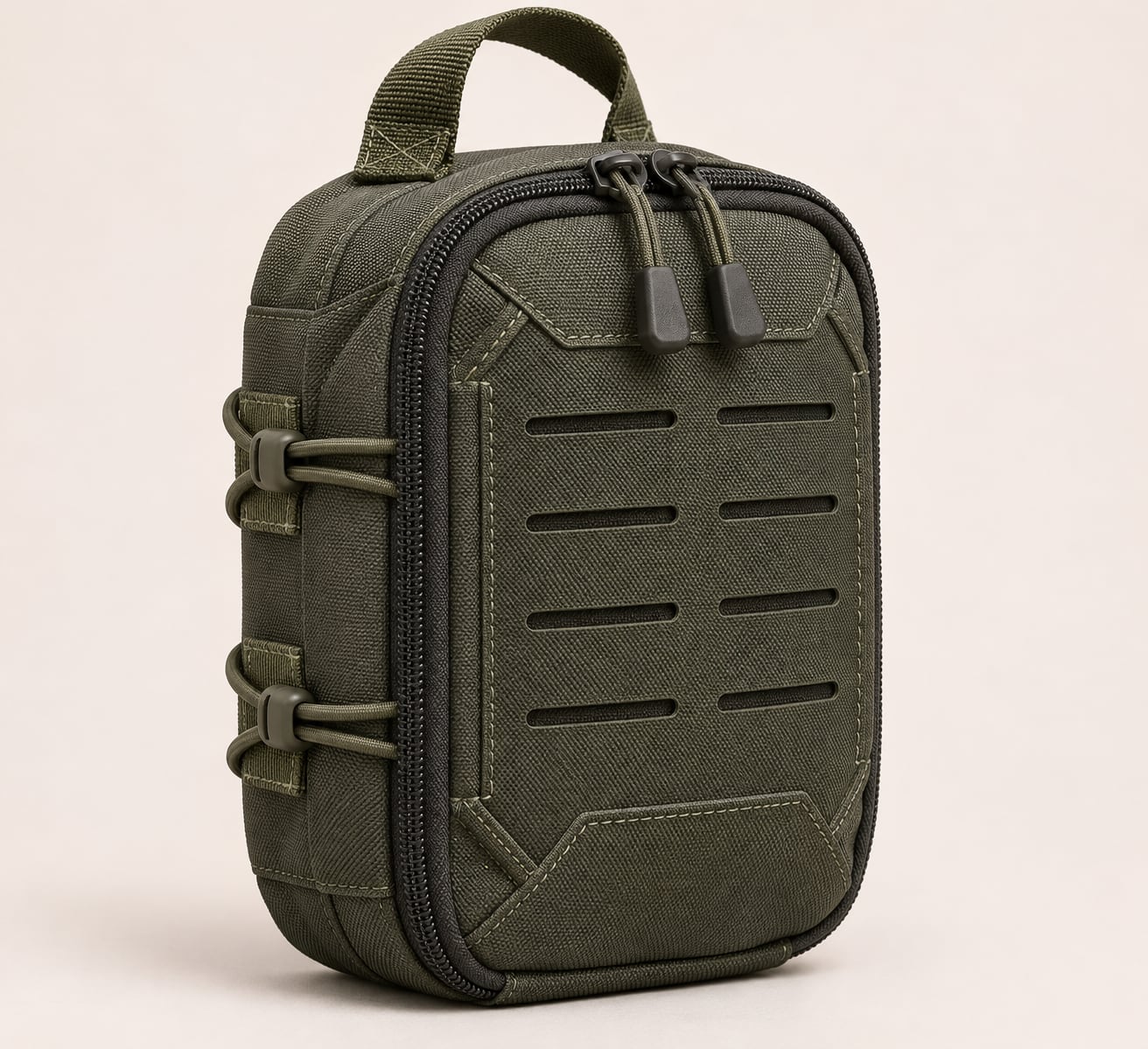
What are the reference design targets?
The source document describes a small first-aid organizer sold empty, with a fold-down front panel, rear MOLLE-compatible mounting and a vehicle-headrest attachment option. The following figures are reference targets for discussion, not specifications that have already passed sample testing.
| Design item | Reference target | What the buyer should confirm |
|---|---|---|
| External size | 17.8 × 12.7 × 7.6 cm (H × W × D) | Measure a filled sample and confirm required capacity and mounting clearance. |
| Body fabric | 100% 1050D nylon in the reference specification | Approve actual denier, hand feel, abrasion performance and color. |
| Opening | Fold-down front panel | Check opening angle, zipper access and how contents are retained. |
| Mounting | Rear MOLLE-compatible interface and headrest option | Fit-test both interfaces; do not assume every vehicle headrest is identical. |
| Organization | Elastic retention, removable compression strap and front loop field | Match the layout to the buyer’s actual contents and identification needs. |
| Moisture management | DWR finish, PU coating and lower drainage eyelets | Agree on project-specific water-resistance and coating tests. |
How should access and internal organization work?
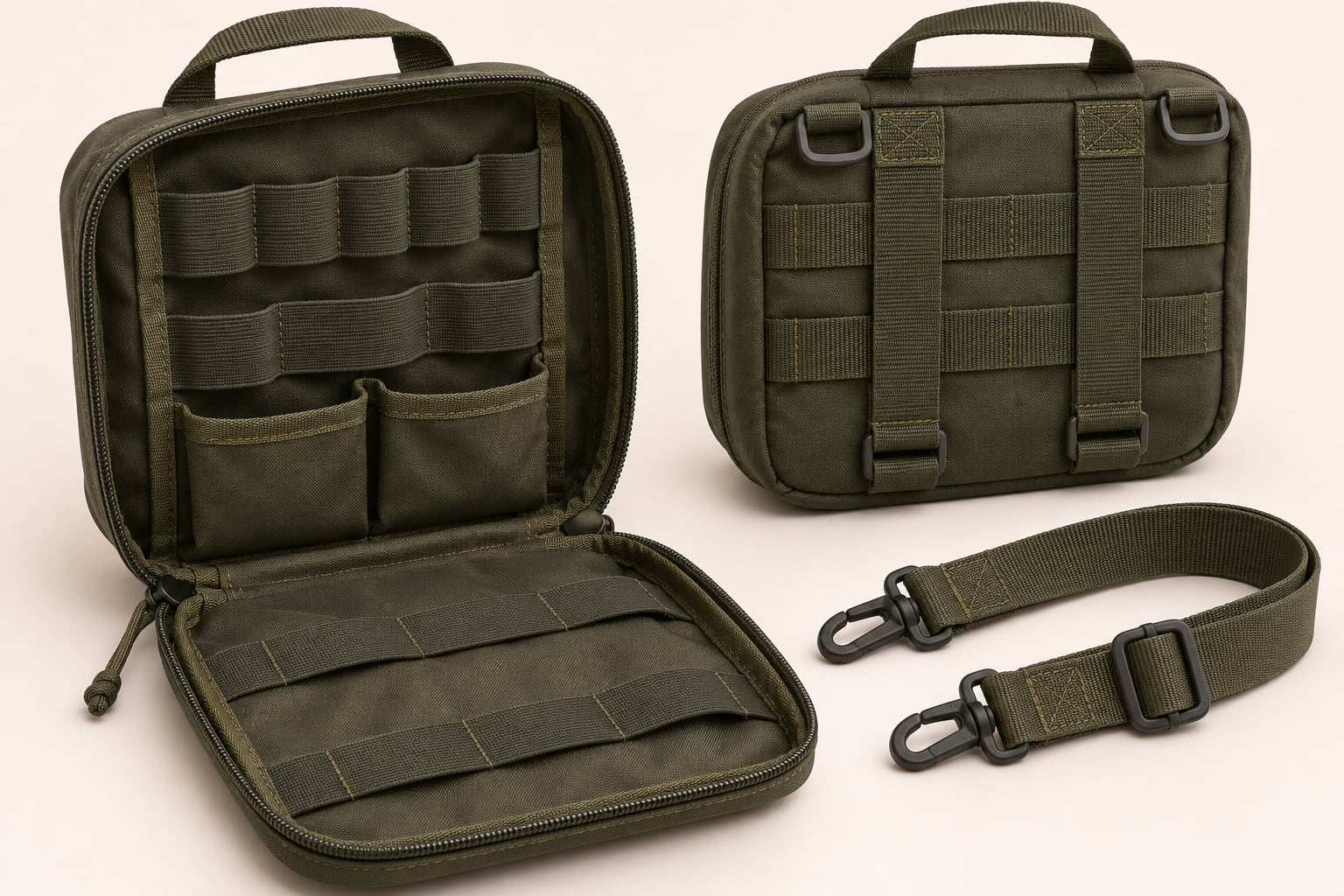
A fold-down front panel puts the interior in view without requiring the user to reach into a narrow top opening. Elastic loops or shock-cord retention can hold selected contents in place, while a removable strap can adjust compression as the load changes. The pouch should still close without forcing the zipper or over-compressing its contents. In the reference document, the indicative space is for essential supplies or one to two compact insert kits; actual capacity depends on the buyer’s chosen items and should be measured with them.
The pouch itself is a storage product, not a medical kit. Medical contents, clinical suitability and operating procedures are outside this bag-design specification.
What should be checked for MOLLE and vehicle mounting?
The reference design combines rear MOLLE-compatible attachment with an integrated vehicle-headrest mounting arrangement. That versatility is useful only if the attachment points, webbing spacing and removable strap are tested in both settings. The RFQ should identify the intended MOLLE platform and the vehicle headrest dimensions. A sample should be mounted, removed and reattached repeatedly, then checked for movement, strap wear and blocked access to the front panel.
The front can include a laser-cut slotted attachment panel plus a loop surface for a removable identification patch. Any patch, color or logo should come from the buyer’s approved artwork rather than from a third-party reference product.
Which materials and weather details matter?
The reference specification calls for 1050D nylon, high-strength nylon webbing, elastic shock cord, a durable water-repellent (DWR) finish and a double PU coating. Those choices should be reviewed against the desired weight, flexibility, cost and sewing performance. Lower eyelets can allow water to drain after exposure, but a coated fabric and drain holes do not make a finished pouch waterproof. The buyer should define any water-resistance claim and test method before it is used in marketing.
For a compact pouch, small construction decisions matter: reinforce handle and mounting-strap stress points, keep zipper pulls accessible with gloves if that is a project requirement, smooth exposed edges, and confirm that eyelets do not snag the intended contents. A physical sample should also establish finished weight; the reference document gives conflicting weight information, so no weight claim is made here.
What should the first sample prove before bulk production?
- Fit and capacity: Pack the buyer’s actual items, measure the filled dimensions and verify that the front panel opens freely.
- Retention: Shake and carry the loaded pouch to check elastic loops, compression cord, removable strap and zipper closure.
- Mounting: Fit-test the MOLLE interface and the specified vehicle headrest separately, including repeated attachment and removal.
- Construction: Inspect stitching, webbing, zipper, laser-cut slots, hook-and-loop field, eyelets and coating consistency.
- Claims and packaging: Confirm fabric composition, color, care label, country-of-origin marking, pack-out and any agreed performance test before approving marketing language.
What information should go into a custom IFAK pouch RFQ?
Send the intended use and mounting platforms, target external size, a measured list of contents, preferred fabric and coating, color, patch or logo artwork, order quantity, destination market and required test standards. If the pouch must fit a particular vehicle or pack, provide those dimensions or physical samples. This gives the factory a basis for a practical pattern, sample and quotation instead of asking it to reproduce a branded reference image.
Senrong Bags can review custom pouch construction as an OEM or ODM project. Explore our custom accessory pouch range and storage-bag formats, or send a project inquiry with your technical requirements. The concept images are unbranded design illustrations and do not imply an affiliation with another bag brand.